



Views
Water bills in context: what the CMA's decision really means
As the dust settles on the Competition and Markets Authority's redeterminations for five water companies, it is worth putting the resulting bill changes that will kick in from April 2027 in their proper context.
Anglian Water, Northumbrian Water, South East Water, Southern Water and Wessex Water will see bills increase by an average of 2.2% compared to Ofwat's original decisions. But the figures in the CMA's decision are set out in 2022-23 prices and are an average over the five years from 2025-2030. When they are finally converted into customer water bills in early 2027, other factors such as inflation adjustments and company performance against regulatory targets will be included.
Bill rises are never welcome, but the money is needed to fund vital upgrades to secure our water supplies, support economic growth and end sewage entering our rivers, lakes and seas. Water companies are more than doubling the help available to customers, with £4.1 billion in financial support available over the next five years for those customers who need it.
To understand why this investment is necessary, it helps to look back. Between 2010 and 2025, water bills actually fell in real terms. Had bills simply kept pace with inflation since 2010, they could have supported the financing of as much as £100 billion of additional investment.
Over the same period, electricity prices more than doubled in real terms.
While hindsight is a wonderful thing, the result is that infrastructure has not been able to be maintained or upgraded as much as it needed to be. As the Independent Water Commission found, "government and regulator pressure on bills played an important role in what can now be seen as underinvestment over this period."
New analysis from Water UK shows that even after recent bill rises have come into effect, water bills will be around 6% higher in real terms than they were in 2010. That increase of £22 in annual bills is after a period of more than 15 years of population growth, climate change pressures and stricter environmental standards rightly demanding swifter action.
Figure 1 - Average water and wastewater bills in real terms (£, 2009-10 prices)
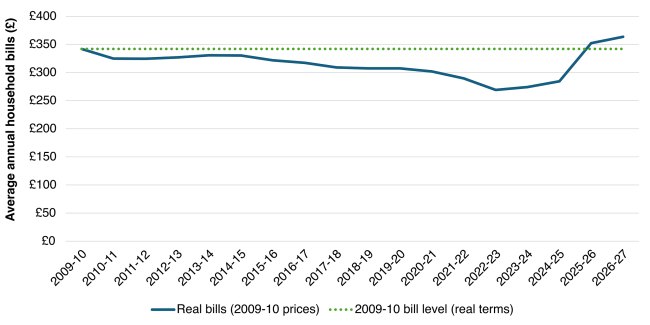
Source: Water UK analysis of average water and wastewater bills. In line with the approach Ofwat takes to setting price limits, we use the retail prices index (RPI) prior to 2020, and the consumer prices index with housing costs (CPIH) for subsequent years.
The story of water bills is one of deferred investment under a regulatory system that is widely recognised to have failed.
Reform is now underway to ensure we never face this experience again. It cannot happen soon enough.
Share


