



Views
No drought surge pricing – here’s what’s actually happening
Following a recent consultation by Ofwat, media coverage suggested water companies want to introduce ‘surge pricing’ in droughts. In fact, there are no such plans. This blog explains what is happening and why.
Read on to find out:
- Why we would need to reduce demand for water even if all leakage was totally eliminated
- The changes being tested to water bills
- How customers are protected by ‘revenue neutrality’ – if companies collect more money from some customers (e.g. heavy water users), they are automatically required to cut bills for others
Why do we need to save water?
By mid-century, England and Wales face a shortfall in water of over five billion litres a day. To close this gap, the plan agreed with government is to build new water supplies, reduce leakage and reduce demand for water. As shown in the chart below, reducing demand contributes nearly half of what’s needed.
Chart One: Meeting the need for five billion more litres of water each day by 2050
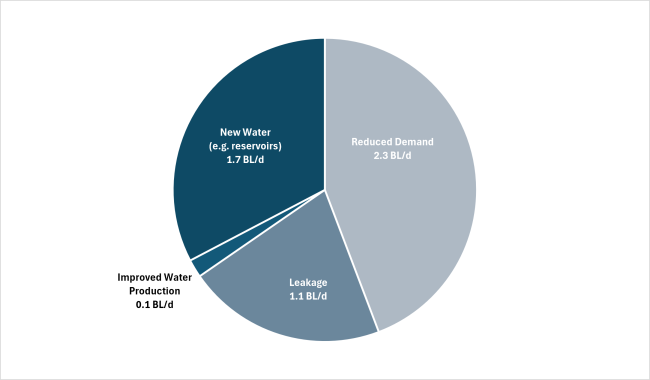
Units are billions of litres of public water supply per day
The relative contributions of demand, leakage and new supply are formally agreed by the Secretary of State. Other choices are possible: for example, if government approved the extra cost on bills, we could reduce leakage even further across the 350,000 km network of water pipes, or add to the ten reservoirs currently being developed. However, even then demand would likely remain important: even if we eliminated every bit of leakage (something no country has ever managed) and delivered the current reservoir programme in full we would still see a gap of around 400 million litres a day.
We know, though, that reducing water demand is hard. People understandably expect to use water freely - whether to keep gardens green or cars clean. A new campaign is explaining why water is precious and needs to be saved but communications alone will be insufficient to meet government’s targets – especially with new demands for water emerging. That's where charging trials come in.
Trialling different ways of charging for water
Ofwat caps the amount of money that a water company can collect from its customers. Within that cap, there are two basic choices: charge every customer on the same basis, or charge more to some customers and less to others where there is a good reason to do so.
Ofwat decided to explore the latter to save water and help affordability. Perhaps reflecting the popularity of new flexible tariffs in energy, in 2022 they called on water companies to trial different approaches to the setting of bills.
Some trials have now completed – for example, Affinity Water’s “WaterSave” trial gave customers 82 litres of free water every day. Customers using more than that were charged more according to their use. Three quarters of participants saved money as well as an average 34 litres of water per day.
Most trials follow this idea of charging less for the first volume of water, with costs progressively increasing for higher users. This is typically done by splitting a household’s water usage into "blocks." The first block represents essential use and is charged at a lower rate (or is even free), while subsequent blocks attract progressively higher rates as consumption rises. This approach is well-established in places like Spain and other countries with a longer history of saving water.
Contrary to some media reporting, no water company has suggested increasing the cost of water in droughts and there are no such plans in company’s proposed trials between now and 2030.
Some companies are testing seasonal charges, increasing the price in summer and decreasing it in winter. This partly reflects the fact that demand can increase by a third during hot summers, making water saving even more important.
Protections for customers
Alongside water saving, one of the two objectives for charging trials has been improving affordability. We think most customers will save rather than lose money. This is due to how consumption ranges between users, with a ‘long tail’ of very heavy water users:
Chart Two: Consumption of Water by Proportion of Households
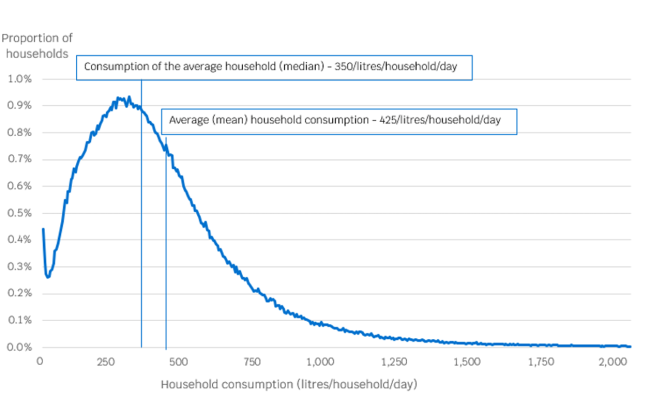
In addition, there are three customer protection measures in place:
- Companies are not allowed to make extra money from changes to the bill. If they collect more money from some customers (for example heavy water users), they are required to reduce costs for others in a ‘revenue neutral’ approach. Ofwat caps the total amount of money a company may collect from customers, so companies can only change the apportionment of revenue between customers - not increase it overall.
- There are exclusions or other protections in place for vulnerable customers (such as those using extra water for medical needs).
- Participation is voluntary and trials are being run under close scrutiny.
Are everyone’s bills about to change?
No. Trials will continue until 2030. In addition, most future charging arrangements depend on the presence of smart meters. While ten million smart meters will be rolled out between now and the end of the decade, most homes will not have them for some time.
Nevertheless, with such a large shortfall in water supplies expected by mid-century, it is right we explore better and more modern ways of charging for water so long as the right safeguards are in place.
Share


