



Views
Looking at the bigger picture on leakage
The unprecedented dry and hot weather the country has been experiencing over the last few weeks is causing very high water demand – a third higher than average for this time of year. As a result, several water companies have reluctantly introduced hosepipe bans to protect the environment, conserve supplies and ensure there is enough water for essential activities.
We understand just how much of an inconvenience hose pipe bans are, which is why water companies only introduce them if they are vital for conserving water. We also understand, and sympathise, with those who are frustrated at being asked not to use a hose when about a fifth of water is lost through leaky pipes.
Here is the story of why pipes leak and what is being done about it.
Why do we have any leakage?
Leakage is the common term for water which cannot be accounted for. It’s around a fifth of all water that is treated and put into the water supply network. That is a lot of water – about 2.9 billion litres a day.
Unaccounted water is lost through leaky old pipes. Some leaky pipes belong to homes and businesses, and the rest belong to water companies.
Finding leaks is difficult and fixing them is both expensive and disruptive. Water company pipes are often very old and made of cast iron which cracks and corrodes over time. The network of water pipes is vast – over 320,000km long. Many of these pipes are buried deep underground and are in densely populated areas.
Every year, a portion of people’s water bills is used to find and repair leaking pipes. In England and Wales, the regulator Ofwat determines how much money water companies can spend on cutting leakage - £1.6 billion in the last year.
Stop/Start Progress
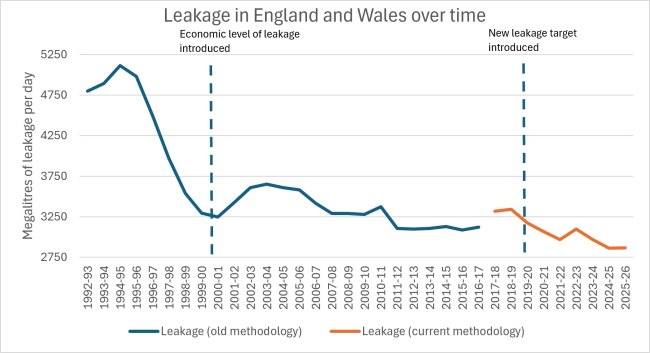
In the early 1990s, we lost a third of all water to leaks. We now lose a fifth, because leakage has fallen by 40% in that time. The reduction has not been consistent however. Finding and repairing leaky pipers (shown in the graph below) can be broken down into three main stages; a big reduction in the mid to late 1990s, followed by a long period with no significant progress, with leakage starting to fall again in 2019.
“Sustainable Economic Level of Leakage”
From around 2000-2019, Ofwat funded leakage activity on the basis of what it deemed to be a “sustainable economic level of leakage”, the level at which it thought it was better to permit leaks rather than raise water bills further to fix them. Recognising public frustration with leakage, for the 2019 Price Review Ofwat changed its approach and since 2019, leakage has been falling. In a little over six years, leakage has fallen 9.5% and it has now never been lower.
Finding and fixing leaks
The industry recognises there is more to do. Most water companies have deployed satellite technology to identify leaks through observing ground conditions from space. Severn Trent are also repurposing unused telecommunications cables – known as “dark fibre” – which run alongside water pipes as continuous highly sensitive leak detectors. Companies are also exploring ‘no dig’ repairs such as deploying robots in pipes to fix small leaks. However, much of this innovation is focused on finding leaks.
The long term technology for fixing leaks has not changed much – digging up and replacing pipes. Tokyo has driven leakage down to around 3%, but it has done so after a 50 year programme of replacing 27,000km of water mains with stainless steel pipes. It cost around £20.5 billion in 2026 prices. If that were replicated across the pipe network in England and Wales, it would cost around £265 billion. That would add around £220 a year to the average water bill – an increase of more than a third on current levels.
The challenge is also getting harder. In prolonged periods of hot dry weather, as we’ve seen in 2025 and 2026, soil dries out, causing the ground to move which can break pipes. In July 2026 Thames Water saw 2,871 visible leaks, compared to 1,727 in 2024 (the last non-drought year). Similarly, it saw 31 major pipe bursts leading to houses losing water supply, compared to 12 in 2024.
Energy ‘leaks’
The water sector is not alone in suffering from losses in the system. About 8.5% of the electricity generated in Great Britain is also lost in transmission via pylons and cables going into homes and businesses, and this loss is set to more than double in volume between now and 2050.
Leakage around Europe
Leaky pipes is a common problem across Europe. Italy loses more than 40% of its water to leaks. Some countries replaced almost all of their metropolitan pipes after the World War II, which is why Germany only loses about 5% of its water to leaks. The UK’s performance is in the top third, with lower leakage than France, Ireland and Italy.
What Next?
Even with new technology, the job is made harder as the easy-to-reach leaks have largely been fixed. Long dry summers are particularly hard on clay soil, which hardens and moves, causing pipes buried in the soil to crack or burst. During the last very hot summer of 2022, South East Water reported that bursts increased by 50%.
Ultimately, fixing leaks takes time and costs money. We can have the level of leakage found in Tokyo, but it would cost a fortune and be hugely disruptive. Nobody likes to see a pipe leaking water, but nobody wants water bills to rise either.
It is for the government to decide what level of leakage it wants. Water companies will work as hard as possible to meet targets and should be penalised whenever they fail to meet them.
Given the potential disruption and costs involved in securing further big reductions to leakage, and the counter-veiling pressure created by bursts that are down to warmer weather, we are overdue a bigger conversation about what trade-offs society is willing to bear to make progress.
Share


